SOAR
Creative Tool with a possibility mindset
SOAR beyond today
SOAR is a whole-system, strategic planning tool that uses a affirmative-centric, participatory, and dialogic approach to strategic thinking.To learn the basics of the tool, scroll below to learn about the four main conversation components that make up this tool: Strengths, Opportunities, Aspirations, and Results. While SOAR as a whole is a strategic thinking tool, there is also a connection from each step to a thinking skill that supports the needed dialogue to advance the strategic process. Connection buttons are provided adjacent each SOAR step below.To dive into the details around SOAR as a whole, use the adjacent menu buttons to learn more.
Strengths
Determining strengths is the ultimate kick-starter to any problem-solving conversation. This is a time to build confidence in what is already present.
Opportunities
Often, what first comes to mind is not the whole picture. Recognizing the fullest context available helps to ground and launch creative effort.
Aspirations
Desires, hopes, dreams, and imagination applied to a context pulls human beings to strive higher, dig deeper, discover more, and grow into their full abilities and intentions.
Results
From a predictive—not reflective—lens, applying possibility thinking to results means not over-romanticizing what "success" might really mean. Perfection is not practical, so there is no reason to expect it.
Sources
Anderson, H., Cooperrider, D., Gergen, K. J., Gergen, M., McNamee, S., & Whitney, D.(2008). The appreciative organization (Vol. 2). Chargin Falls, OH: Taos Institute Publishing.Cameron, K., Dutton, J., & Quinn, R.E. (2003). Positive organizational scholarship: Foundations of a new discipline. San Francisco: Berrett-Koehler.Glăveanu, V. P. (2023). Possibility studies: A manifesto. Possibility Studies & Society, 1(1-2), 3-8.Saint, D. K., Stavros, J. M. (2010). SOAR: Linking Strategy and OD to Sustainable Performance. In W. J. Rothwell, J. M. Stavros, R. L. Sullivan, & A. Sullivan. (Eds.) Practicing Organization Development: A Guide for Leading Change (3rd ed., pp. 377-394). Pieiffer.
Authorship
This site was compiled and created by Robbie Spofford for an educational and research purpose.
Last Updated: August 2026.
SOAR - Design & History
SOAR (Strengths - Opportunities - Aspirations - Results) is a creative problem solving tool that "integrates appreciative inquiry, positive organizational scholarship, and whole system- and strengths-based change" to foster strategic transformation (Saint and Stavros, 2010, p. 378). Developments in the field of strategy and organizational development are increasingly turning toward more strengths-based techniques to foster higher stakeholder engagement and drive better outcomes (Cameron, Dutton, and Quinn, 2003). SOAR implements these developments with a participatory approach and is built off the 5-Is framework from the field of appreciative inquiry: Initiate, Inquire, Imagine, Innovate, and Inspire.After initiating the use of the tool, the design is that each of the remaining four Is with a letter of SOAR to provide an affirming, strengths-based direction for team dialogue:
Inquire into Strengths
Imagine the Opportunities
Innovate to reach Aspirations
Inspire to achieve ResultsThe tool itself is rooted in stakeholder conversations. To understand how this looks in practice, use the button below to view an example.A predecessor tool to SOAR commonly used in creative problem solving, SWOT (Strengths - Weaknesses - Opportunities - Threats), is easy to conflate with SOAR, but it is fundamentally different. To understand the underlying characteristics between SWOT and SOAR, follow the other button below.
SWOT (Strengths - Weaknesses - Opportunities - Threats) is a traditional tool for strategic analysis that is largely a matrix of two variables: externality and positivity. In other words, two axis can be drawn, one with labels "internal - external" and another with labels "positive - negative," and the four items of SWOT represent the four combinations of these terms:
Strengths - Internal, Positive
Weaknesses - Internal, Negative
Opportunities - External, Positive
Threats - External, NegativeAdvances in organizational development theory have brought to light that, in the course of strategic conversations, "any considerations of strengths implicitly considers weaknesses and, similarly, opportunities are developed in consideration of threats" (Saint and Stavros, 2010, p. 378). SOAR maintains the externality variable but replaces the positivity variable with possibility. This creates the following four combinations for SOAR:
Strengths - Internal, Current
Opportunities - External, Current
Aspirations - Internal, Possible
Results - External, PossibleBy using possibility thinking in SOAR, discovery and exploration of a wide spectrum of negative, positive, and neutral emotions can surface at any time in any step of the tool. This open exploration of persons intertwined with their environments, with a balanced focus on what is currently present and what is possible, makes this a tool for whole-system strategic planning. (For more info on the systemic nature of possibilities, see Glăveanu, 2023, p. 5, assertion 7)
SOAR is a tool for strategic thinking, grounded in the dialogue of stakeholders of an organization, group, or movement. As described on the Design & History page (linked via button here), the tool is used in tandem with the 5Is approach: Initiate, Inquire, Imagine, Innovate, and Inspire.Initiate:
For this demonstration, consider there is a group of doctoral students at Buffalo State University that wants the effects or implications of offering free tuition for doctoral students. They come together, set aside time to use SOAR to think strategically, and generate the following:Inquire into Strengths:
The students discuss among themselves and inquire what strengths may be present for making tuition free for their program:
- Doctoral students attending Buffalo State would have more available financial resources
- Low-no cost doctoral programs would engage a broader audience of potential students
- More applicants for doctoral programs would likely strengthen the admitted students each year
- Less administration would be needed to handle the processing of funds, so more time and resources could be put towards growth of programmingImagine the Opportunities:
The students then imagine what free tuition for doctoral students might afford and create:
- Encourage and sustain a more diverse student body (no longer driven by financial constraints)
- Doctoral students with financial need would be supported without them having to use resources to explain their circumstances
- A natural re-assessment of staffing needs could help the institution learn how much administration is truly needed to keep programs running smoothlyInnovate to reach Aspirations:
Students then would discuss how potential innovations could help make the idea of free doctoral student tuition a reality:
- Program fund-raising could become a collaborative effort among students, instead of the traditional, individual burden
- Doctoral students could vote on what components of the program they believe are truly necessary to keep or not and therein better align the program to student needsInspire to achieve Results:
Lastly, the students would find ways that could inspire themselves, faculty, staff, and all stakeholders to practically reach this potential result of free doctoral student tuition:
- Doctoral students would share a more positive reputation of the school, as one that really cares about the financial well-being of its students
- Buffalo State could compete with institutions that offer funding packages
- International acclaim could come from having such a high-quality, low-cost doctoral program
- The learning and research processes would be more enjoyable for doctoral students, without the financial burden of tuition
- More diverse and representative cohorts would improve the quality of the programIt's important to remember, that as with any creative thinking tool, SOAR can be customized to meet the circumstances. This example primarily looks at positives, but SOAR can similarly be used to assess and strategize how to avoid or prepare and anticipate negative aspects of an idea or situation too. For more details, see "Using SOAR" below:
When a group forms and initiates the SOAR process, it's often helpful to organize both questions and the related responses into a grid format, as shown below:
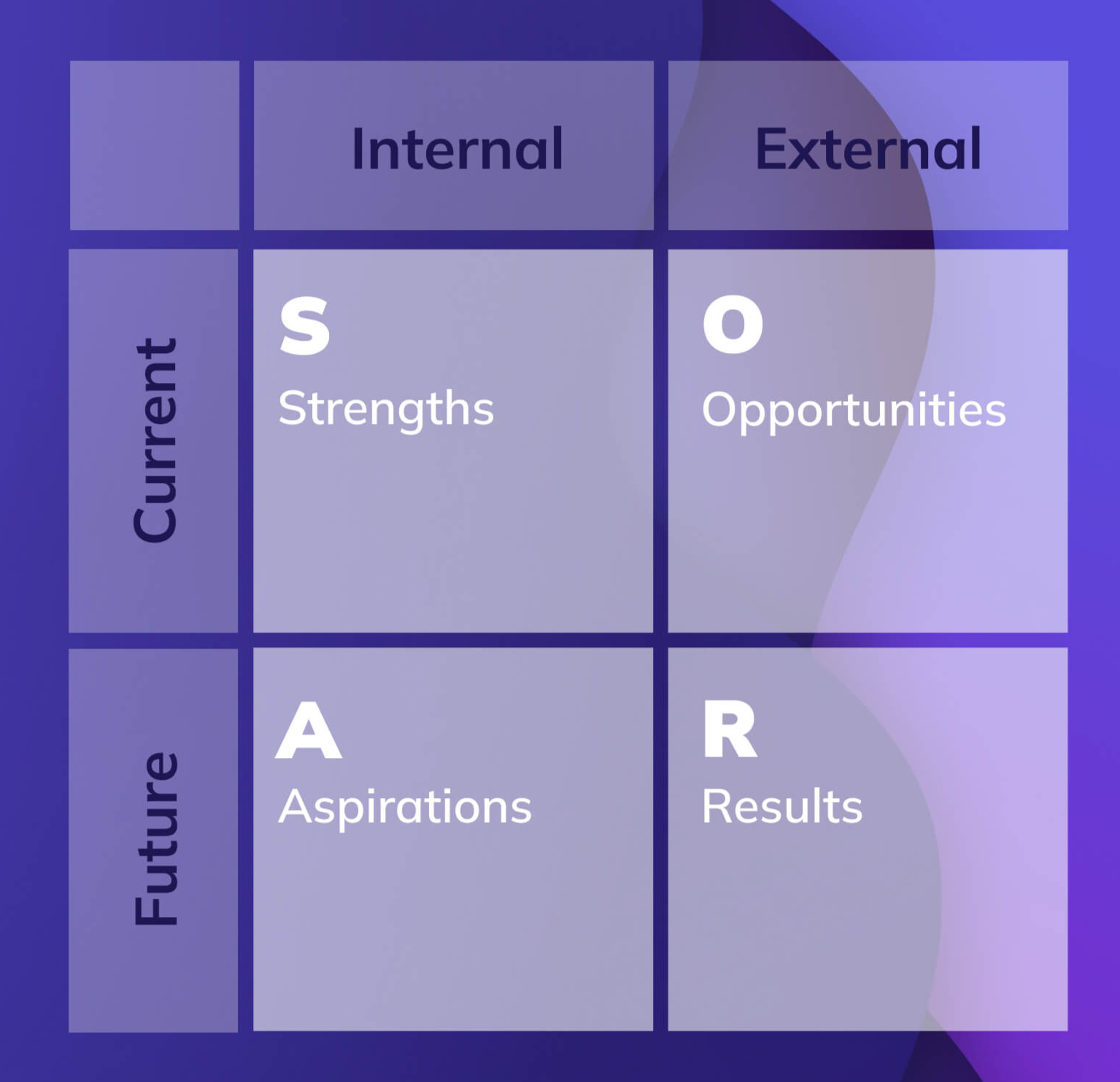
In each quadrant, start with questions related to each of the four sections, and progress in the order of the acronym through all four parts. This starts the group with the internal, current reality and moves incrementally toward less certain sections: externally, and then toward future possibilities. Questions should be primarily open-ended and tailored to the given context. Demonstrating with the topic provided in this website's example:Strengths:
- What might go well if tuition were to be free for doctoral students?
- How might we realize benefits from a decision to make tuition free for doctoral students?Opportunities:
- What might be all the ways having free tuition afford more resources to the program or its students?
- How might making tuition free for doctoral students create new partnerships or opportunities for more diverse academic relationships?Aspirations:
- How might Buffalo State remain financially stable, even if tuition is free for doctoral students?
- In what ways might program expenditures be reduced to compensate for free tuition for doctoral students?Results:
- How might we be confident in the long-term stability of the doctoral program, if tuition was free?
- In what ways might there be flexibility after tuition is made free for doctoral students, so the program can be resilient to unanticipated consequences?After questions are developed, shared, and used to generate responses for each of the four quadrants, in order, each quadrant can then be reviewed individually. Top ideas the entire team agrees upon should be denoted, but those with disagreement should not be ignored. While the purpose is to build consensus and momentum toward a goal, acknowledging and leaving room for differences of perspective and healthy conflict is vital to ensuring SOAR does not deviate from its strategic purpose. Group facilitators or leaders should dedicate time for those ideas group members don't agree on separately, even if short, as not to fully distract from how the group is progressing through SOAR.As review progresses through each quadrant, differences and conflicts are addressed, and group members vote on their favorites to highlight, facilitators can also confirm with the group if something is in the correct quadrant or not. It's not uncommon for ideas to percolate during one phase of the process,
but then actually be more applicable in another.After conflicts have been addressed, some question responses have been re-categorized if needed, and the top 2-4 responses in each quadrant are selected, other tools can take this 4-quadrant output from the SOAR process into the next step(s) of the creative processes, as time and resources provide.
Inquiring into Strengths
Inquiring into strengths is an exercise that is most closely related to diagnostic thinking, as its purpose is to more completely comprehend a situation. Often, the most helpful resources that are needed to solve a problem already exist and just need to be used in a different way: whether that's human capital, physical capital, relationships, or knowledge. It's vital to elevate these at the forefront of the strategic process using diagnostic thinking, as identifying strengths and available assets establishes the guidelines for the remaining conversations in the SOAR process.To support this, it's also valuable to utilize the affective skill of mindfulness to mitigate cognitive biases and blind spots and encourage group members to remain open to new perspectives. This helps to ensure the strengths "hiding in plain sight" are named and made visible for everyone in a community to see, incorporate, and understand.
Imagining Opportunities
Imagining opportunities is an exercise that is most closely related to contextual thinking, as it is rooted in understanding the interrelated attributes of the external environment in a current reality. As is mentioned in various parts of this site, while using a positive approach to SOAR can be valuable, elevating negative thoughts in the process can be just as, if not more, valuable as well. Contextual thinking can be used to name both currently visible opportunities for decline or failure (i.e., concerns) and opportunities for growth or success (i.e., hopes).Being sensitive to and fully aware of the environment during this process is key to recognizing the opportunities already present, before moving on to what is possible with fewer constraints. By ensuring thorough comprehension of present strengths and opportunities before proceeding to potential aspirations and results, group members can help to prevent something from being missed in SOAR's overall strategic analysis.
Innovating to reach Aspirations
Innovating to reach aspirations naturally bridges two cognitive creative skills, visionary and ideational thinking, and two affective creative skills, dreaming and playfulness. Making explicit the hopes and dreams for how to navigate a situation are important, as they provide a direct on-ramp for less engaged community members to become more engaged in the problem solving process. Innovating to reach aspirations also doesn't happen in a simple vacuum by creating a list and moving on. Healthy innovation requires a supportive, playful environment that is open to radically new approaches, alternatives, and possibilities. It is by operating with a possibility mindset that the greatest benefits of SOAR can be realized.
Inspiring to achieve Results
Inspiring to achieve results is all about anticipating what might happen, whether positive, negative, or neutral. This provides both a self-reflective check that this is the desired path forward and an exploration of unintended consequences. Inspiration to achieve positive (or to avoid negative) results requires significant tolerance for risks, as there are always natural variations that can't be fully controlled.Healthy team inspiration includes acknowledging the possibility of shortcomings or failure to achieve desired results. By acknowledging and addressing such a potential, group members can operate with increased confidence in their ability to achieve desired results and make positive possibilities the reality.